


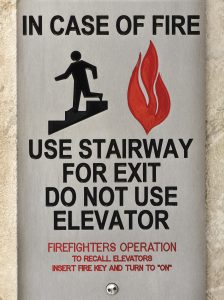
 While we plan for fire emergencies in our own homes, business and leisure travelers often neglect to prepare for an emergency while staying in a hotel. It is important to check for fire safety measures prior to selecting a hotel and to review potential fire evacuation routes upon arrival.
The National Fire Prevention Association (NFPA) urges travelers to practice the following fire safety tips:
Be Safe When Traveling
- Choose a hotel/motel that is protected by both smoke alarms and a fire sprinkler system.
- When you check in, ask the front desk what the fire alarm sounds like.
- When you enter your room, review the escape plan posted in your room.
- Take the time to find the exits and count the number of doors between your room and the exit. Make sure the exits are unlocked. If they are locked, report it to management right away.
- Keep your room key by your bed and take it with you if there is a fire.
- If the alarm sounds, leave right away, closing all doors behind you. Use the stairs — never use elevators during a fire.
- If you must escape through smoke, get low and go under the smoke to your exit.
If You Can’t Escape …
- Shut off fans and air conditioners.
- Stuff wet towels in the crack around the doors.
- Call the fire department and let them know your location.
- Wait at the window and signal with a flashlight or light colored cloth.
Victims of Hotel Safety Negligence: What Are My Legal Options for Justice and Compensation?
As each case and property is unique, victims of hotel safety negligence should speak with an experienced premises liability firm as soon as possible to ensure all evidence, such as surveillance footage or faulty wiring, is preserved and their best interests are protected.
 As the holiday season ushers in cooler temperatures, it is important for nursing home staff and family of nursing home residents to review fire safety plans. Reduced staff during holidays and winter fire hazards, such as space heaters, can be a deadly combination. Family members should check with nursing home administration to be sure they have an emergency preparedness and evacuation plan, particularly for residents with limited mobility.
 The Murray Law Firm has recovered millions of dollars for victims of unsafe properties in Georgia, and recently obtained a $29.25 million dollar verdict for one of our Georgia Clients in Fulton County State Court.