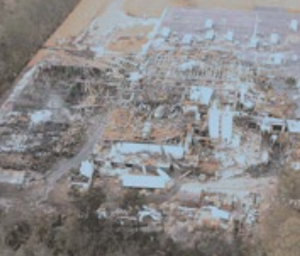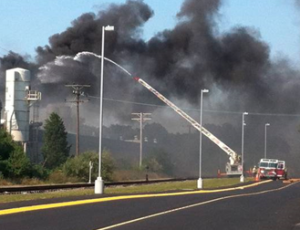
Wood Pellet Plant Explosion (The Providence Journal)

Wood Pellet Plant Explosion (The Providence Journal)

Woodworking facilities have an especially high risk of fires and explosions due to the large quantities of on-site fuel and ignition sources. OSHA outlines the explosive hazards inherent to the woodworking industry and offers multiple solutions to prevent and mitigate these risks. We’ve highlighted some of these hazards and solutions below.

Woodworking Facility Fuel and Ignition Sources

  • [Woodworking facilities] contain large quantities of fuel in the form of wood and wood products, sawdust, and flammable materials such as paints, oil finishes, adhesives, solvents, and liquid propane for internal combustion engines. Woodworking facilities are especially at risk for fire due to the abundant production of sawdust, which will ignite and burn far more easily than whole pieces of lumber. Sanders, routers, and shapers in particular produce large amounts of fine dust. Very fine wood dust is especially hazardous. It can accumulate on rafters and other building structural components and in unexpected spots all around your facility, far from the point of generation. 
  • [Woodworking facilities] contain ignition sources, such as potentially faulty electrical wiring, cutting and welding operations, sparking tools, propellant actuated tools, and employee smoking. There is also the potential for static electrical discharges and lightning.

Possible Solutions

Preventing the buildup of dust is one of the key means for controlling fire and explosion hazards. The principal engineering control technology for control of dust is exhaust ventilation. The primary work practice control is good housekeeping. 

Dust collection is best accomplished at the source-at the point of operation of the equipment, if feasible. For many pieces of equipment, well-designed ducts and vacuum hoods can collect most of the dust generated before it even reaches the operator. Very fine dust that manages to escape point-of-source collection can be captured from above by general exhaust points located along the ceiling. These control technologies are effective for most equipment, excepting machines that commonly produce the very finest dust or large quantities of dust.

Good housekeeping extends to periodic hand cleaning of your entire facility, as some dust will escape from even the best exhaust system and will eventually accumulate on rafters and other out-of-the- way spots. Also, it is extremely important to inspect and clean your exhaust ventilation system on a regular basis to maintain maximum efficiency.

Additional Prevention Tips

  • Ensure the proper use and storage of flammable materials, such as paints, finishes, adhesives, and solvents.
  • Segregate tasks particularly prone to fire and explosion hazards, such as spray painting, welding, and use of powder-actuated nail guns.
  • Train employees to recognize, avoid, and correct potentially hazardous conditions and behaviors. Train employees so that they are acquainted with the special equipment and aspects of building design related to dealing with fires and explosions.
  • Control ignition sources. This involves using electrical systems rated for the projected use and protected by appropriate circuit breakers, grounding all equipment prone to accumulating static electrical charges, grounding entire buildings against the possibility of lightning strikes, and controlling and banning smoking in and around the workplace. Consult Subpart S of OSHA’s General Industry Standards for more information on electrical design requirements.
  • Never permit blow-down of accumulated dust with compressed air. Blowing dust with compressed air will create the very type of dust cloud that presents the greatest explosion hazard.
  • Provide continuous local exhaust ventilation on all woodworking machines. The local exhaust systems must have a suitable collector. Dust collection systems must be located outside the building, unless the exceptions described in NFPA standards are met.
  • Segregate combustible and flammable materials such as lumber stock and chemical solvents from each other and from ignition sources.
  • Ensure that you use equipment with a hazard classification appropriately rated for your work environment.

Protecting Employees

  • Install an alarm system to warn for necessary action or safe escape [29 CFR 1910.165].
  • Establish emergency plans and fire prevention plans [29 CFR 1910.38].
  • Install battery-operated emergency lighting along the floor to aid in the evacuation of smoke- filled buildings.
  • Store fire-retardant blankets, clothing, and masks in areas where workers could conceivably need them to pass through smoke and flames to reach exits.
  • Maintain first-aid kits designed for the initial treatment of burns and smoke inhalation. These kits should be stored outside the area of fire risk.

The Murray Law Firm works tirelessly to protect Clients who have been injured or lost loved ones in catastrophic factory explosions and fires. In their honor, we urge all woodworking plants and mills to heed OSHA guidelines and make employee safety their first priority. For a complete list of facility hazards and solutions, please visit the OSHA website.

We Fight for Victims of Catastrophic Workplace Accidents in Georgia …Contact us Now for a Free Consultation.

The Murray Law Firm has recovered millions of dollars for victims of catastrophic workplace accidents in Georgia, and we offer our legal assistance if desired.  We represent our Clients on a contingency agreement, which generally means that no fees or payments are owed until and unless we recover. Anyone seeking further information or legal representation is encouraged to contact us via e-mail (click here) or by telephone at 888.842.1616. Consultations are free and confidential.

728x90 Justice


Choosing the Right Attorney

Selecting the right attorney for you or your family is highly important. You must feel confident that the attorney you hire has a complete understanding of the law applicable to your particular case, and has successful experience in handling such cases.

Important: Do not hire a lawyer who has violated the Rules of Professional Conduct!!!

You should not hire an attorney who calls you or visits you unsolicited, or anyone that contacts you directly to offer legal services. This activity is strictly prohibited by Rule 7.3 of the American Bar Association (ABA) Model Rules of Professional Conduct, which states as follows:
ABA Center for Professional ResponsibilityA LAWYER “SHALL NOT” CONTACT A PROSPECTIVE CLIENT THROUGH A “LIVE TELEPHONE” OR AN “IN-PERSON” VISIT.

– RULE 7.3, ABA MODEL RULES OF PROFESSIONAL CONDUCT.

If an attorney, or someone acting on behalf of an attorney, contacts you in this manner, that attorney is in violation of this Rule. This unethical and unprofessional activity on the part of the lawyer is good sign that you should stay away. It is imperative that you are represented by an attorney who is capable of advocating for you within the confines of the law, and an attorney who fails to abide by the Rules of Professional Conduct is probably not the best fit. In fact, any such attorney should be immediately reported to the local State Bar Association. If you have been contacted in such an unsolicited manner, contact us and we’ll assist you in filing a report.

SAC EM Update

Contingency Fees Disclaimer: “Contingent attorneys’ fees refers only to those fees charged by attorneys for their legal services. Such fees are not permitted in all types of cases. Court costs and other additional expenses of legal action usually must be paid by the client.

Pharmaceutical Plant After Dust Explosion (OSHA)

Pharmaceutical Plant After Dust Explosion (OSHA)

The Occupational Safety and Health Administration (OSHA) highlights the explosive dangers of combustible dust, the industries most at risk, and what employers and employees can do to prevent and mitigate these risks.

OSHA Hazard Alert: Combustible Dust Explosions:

Combustible dusts are fine particles that present an explosion hazard when suspended in air in certain conditions. A dust explosion can be catastrophic and cause employee deaths, injuries, and destruction of entire buildings. In many combustible dust incidents, employers and employees were unaware that a hazard even existed. It is important to determine if your company has this hazard, and if you do, you must take action now to prevent tragic consequences.

How Dust Explosions Occur

In addition to the familiar fire triangle of oxygen, heat, and fuel (the dust), dispersion of dust particles in sufficient quantity and concentration can cause rapid combustion known as a deflagration. If the event is confined by an enclosure such as a building, room, vessel, or process equipment, the resulting pressure rise may cause an explosion. These five factors (oxygen, heat, fuel, dispersion, and confinement) are known as the “Dust Explosion Pentagon”. If one element of the pentagon is missing, an explosion cannot occur.

(OSHA)

(OSHA)

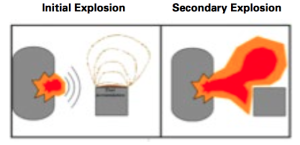
Catastrophic Secondary Explosions

An initial (primary) explosion in processing equipment or in an area where fugitive dust has accumulated may dislodge more accumulated dust into the air, or damage a containment system (such as a duct, vessel, or collector). As a result, if ignited, the additional dust dispersed into the air may cause one or more secondary explosions. These can be far more destructive than a primary explosion due to the increased quantity and concentration of dispersed combustible dust. Many deaths in past incidents, as well as other damage, have been caused by secondary explosions.

Industries at Risk

Combustible dust explosion hazards exist in a variety of industries, including: agriculture, chemicals, food (e.g., candy, sugar, spice, starch, flour, feed), grain, fertilizer, tobacco, plastics, wood, forest, paper, pulp, rubber, furniture, textiles, pesticides, pharmaceuticals, tire and rubber manufacturing, dyes, coal, metal processing (e.g., aluminum, chromium, iron, magnesium, and zinc), recycling operations, fossil fuel power generation (coal), and 3D welding (a form of 3D printing).

Prevention of Dust Explosions

  • Identify factors that may contribute to a explosion, OSHA recommends a thorough hazard assessment of:
    • All materials handled;
    • All operations conducted, including by-products;
    • All spaces (including hidden ones); and
    • All potential ignition sources.

Dust Control Recommendations

  • Implement a hazardous dust inspection, testing, housekeeping, and control program;
  • Use proper dust collection systems and filters;
  • Minimize the escape of dust from process equipment or ventilation systems;
  • Use surfaces that minimize dust accumulation and facilitate cleaning;
  • Provide access to all hidden areas to permit inspection;
  • Inspect for dust residues in open and hidden areas at regular intervals;
  • If ignition sources are present, use cleaning methods that do not generate dust clouds;
  • Use only vacuum cleaners approved for dust collection; and
  • Locate relief valves away from dust deposits.
  • Ignition Control Recommendations
  • Use appropriate electrical equipment and wiring methods;
  • Control static electricity, including bonding of equipment to ground;
  • Control smoking, open flames, and sparks;
  • Control mechanical sparks and friction;
  • Use separator devices to remove foreign materials capable of igniting combustibles from process materials;
  • Separate heated surfaces from dusts;
  • Separate heating systems from dusts;
  • Select and use industrial trucks properly;
  • Use cartridge-activated tools properly; and
  • Use an equipment preventive maintenance program.

Injury and Damage Control Methods

  • Separation of the hazard (isolate with distance);
  • Segregation of the hazard (isolate with a barrier); • Deflagration isolation/venting;
  • Pressure relief venting for equipment;
  • Direct vents away from work areas;
  • Specialized fire suppression systems;
  • Explosion protection systems;
  • Spark/ember detection for suppression activation;
  • Develop an emergency action plan; and
  • Maintain emergency exit routes.

We Fight for Victims of Catastrophic Workplace Accidents in Georgia …Contact us Now for a Free Consultation.

The Murray Law Firm has recovered millions of dollars for victims of catastrophic workplace accidents in Georgia, and we offer our legal assistance if desired.  We represent our Clients on a contingency agreement, which generally means that no fees or payments are owed until and unless we recover. Anyone seeking further information or legal representation is encouraged to contact us via e-mail (click here) or by telephone at 888.842.1616. Consultations are free and confidential.

728x90 Justice


Choosing the Right Attorney

Selecting the right attorney for you or your family is highly important. You must feel confident that the attorney you hire has a complete understanding of the law applicable to your particular case, and has successful experience in handling such cases.

Important: Do not hire a lawyer who has violated the Rules of Professional Conduct!!!

You should not hire an attorney who calls you or visits you unsolicited, or anyone that contacts you directly to offer legal services. This activity is strictly prohibited by Rule 7.3 of the American Bar Association (ABA) Model Rules of Professional Conduct, which states as follows:

ABA Center for Professional ResponsibilityA LAWYER “SHALL NOT” CONTACT A PROSPECTIVE CLIENT THROUGH A “LIVE TELEPHONE” OR AN “IN-PERSON” VISIT.

– RULE 7.3, ABA MODEL RULES OF PROFESSIONAL CONDUCT.

If an attorney, or someone acting on behalf of an attorney, contacts you in this manner, that attorney is in violation of this Rule. This unethical and unprofessional activity on the part of the lawyer is good sign that you should stay away. It is imperative that you are represented by an attorney who is capable of advocating for you within the confines of the law, and an attorney who fails to abide by the Rules of Professional Conduct is probably not the best fit. In fact, any such attorney should be immediately reported to the local State Bar Association. If you have been contacted in such an unsolicited manner, contact us and we’ll assist you in filing a report.
SAC EM Update

Contingency Fees Disclaimer: “Contingent attorneys’ fees refers only to those fees charged by attorneys for their legal services. Such fees are not permitted in all types of cases. Court costs and other additional expenses of legal action usually must be paid by the client.

(Savannah Morning News)

(Savannah Morning News)

Community Calls for End to Violence

Two hundred people took to Savannah streets Saturday evening in an effort to raise community awareness of local violence. Marchers wore “We Must Do Something” t-shirts while praying, singing and engaging neighbors in topics, such as jobs and community resources for poverty-stricken neighborhoods.

Per media reports, marchers targeted “men ages 18-25, the group hardest hit by and, sometimes, involved in the violence.”

According to Savannah Morning News, the march capped off a week of Savannah anti-violence rallies.

“There was a rally Monday. There was a rally Wednesday after a 20-year-old man was shot to death at Fred Wessels homes the previous evening. There was a rally Thursday night in Savannah’s Metropolitan neighborhood, and another Friday in Midtown. There was one Saturday morning in Johnson Square. What’s notable is that, over the past week, rallying has become jst as routine as the violence residents are protesting.”

Savannah-Chatham Police have reportedly investigated over 170 shootings this year and media reports indicate, “violent crime is up more than 20 percent from this time last year.”

Many of the week’s rallies focused on the need for people to speak up and help police protect their community.

“People who protect killers need to step to the plate and give police information that will help them catch the people who are wreaking havoc on the city’s peace of mind.”

Rally organizer, Shawntray Grant, asked neighbors to “stop laying the blame on police and public officials” during his Wednesday rally. Mr. Grant reportedly reminded the community that law enforcement officials can’t do their jobs without “tangible help from residents.”

Assistant Police Chief Julie Tolbert believes, “everyday residents actually going out and calling on the community to to quit protecting killers is a big deal.”

What Can Property Owners Do to Help?

Equally as important as raising public awareness of the ongoing community violence, and its affect on Savannah families, is preventing it. Many of these violent crimes have occurred in apartment complexes, parking lots, hotels, and nightclubs throughout Savannah. It is time Savannah property owners follow the example of their neighbors and take measures to protect our families and deter such crime.

By law, Georgia apartment, parking lot, hotel, and nightclub owners have a duty to protect all patrons legally on their property from foreseeable harm. Should the property owners or managers fail in this responsibility, they may be held civilly liable for any injuries or wrongful deaths which occur as a consequence.

As the Savannah community raises awareness of local violence, responsible Savannah property owners can help us to prevent it. Perhaps, together, many lives may be spared.

We Fight for Victims of Violence in Savannah…Contact us Now for a Free Consultation.

The Murray Law Firm has recovered millions of dollars for victims of violence and security negligence in Georgia, and we offer our legal assistance if desired.  We represent our Clients on a contingency agreement, which generally means that no fees or payments are owed until and unless we recover. Anyone seeking further information or legal representation is encouraged to contact us via e-mail (click here) or by telephone at 912.385.9690. Consultations are free and confidential.

728x90 Justice


Choosing the Right Attorney

Selecting the right attorney for you or your family is highly important. You must feel confident that the attorney you hire has a complete understanding of the law applicable to your particular case, and has successful experience in handling such cases.

Important: Do not hire a lawyer who has violated the Rules of Professional Conduct!!!

You should not hire an attorney who calls you or visits you unsolicited, or anyone that contacts you directly to offer legal services. This activity is strictly prohibited by Rule 7.3 of the American Bar Association (ABA) Model Rules of Professional Conduct, which states as follows:

ABA Center for Professional ResponsibilityA LAWYER “SHALL NOT” CONTACT A PROSPECTIVE CLIENT THROUGH A “LIVE TELEPHONE” OR AN “IN-PERSON” VISIT.

– RULE 7.3, ABA MODEL RULES OF PROFESSIONAL CONDUCT.

If an attorney, or someone acting on behalf of an attorney, contacts you in this manner, that attorney is in violation of this Rule. This unethical and unprofessional activity on the part of the lawyer is good sign that you should stay away. It is imperative that you are represented by an attorney who is capable of advocating for you within the confines of the law, and an attorney who fails to abide by the Rules of Professional Conduct is probably not the best fit. In fact, any such attorney should be immediately reported to the local State Bar Association. If you have been contacted in such an unsolicited manner, contact us and we’ll assist you in filing a report.
SAC EM Update

Contingency Fees Disclaimer: “Contingent attorneys’ fees refers only to those fees charged by attorneys for their legal services. Such fees are not permitted in all types of cases. Court costs and other additional expenses of legal action usually must be paid by the client.